
Buying a home in California follows six stages: set a payment and cash budget, arrange financing and representation, investigate homes, negotiate an offer, complete escrow checks, then sign, fund and record the transfer. The key is knowing what decision and document each stage requires. A pre-approval is not final loan approval, a deposit is part of your purchase cash rather than an extra down payment, and signing loan papers does not by itself mean you own the home.
Updated October 13, 2026. This guide uses a hypothetical $1.2 million purchase to make the steps concrete. Rates, costs and timelines are illustrative, not a loan quote or California market average. Your signed contract supplies the actual transaction deadlines.
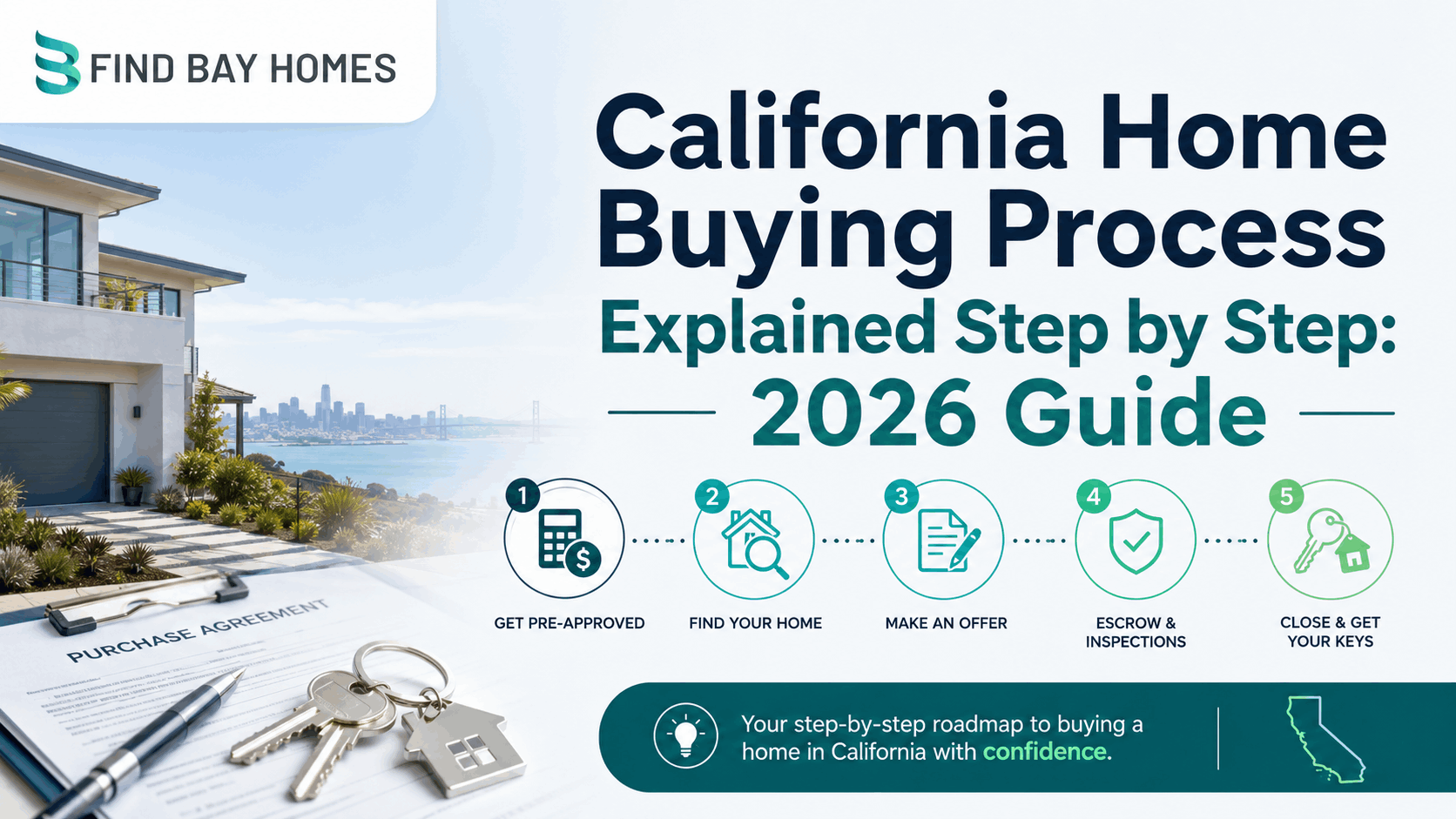
The California home-buying process at a glance
| Stage | Your concrete output | Decision before moving on |
|---|---|---|
| Budget and financing | Monthly ownership budget, cash-to-close plan, lender document review | Can you afford this purchase without exhausting your reserves? |
| Representation and search | Written representation agreement and ranked search criteria | Do the services, compensation and search area fit your needs? |
| Property and offer | Comparable sales, disclosure issue list and signed offer terms | What price and risks are you willing to accept? |
| Escrow investigation | Inspections, title/HOA review, insurance, appraisal and underwriting | Are the remaining risks and costs acceptable before removing protections? |
| Closing preparation | Closing Disclosure, final walkthrough and verified funds instructions | Do the final dollars and property condition match the agreement? |
| Completion | Funding/recording confirmation and agreed possession | Has escrow confirmed closing and is it time to receive keys? |
Step 1: Set both a monthly budget and a cash budget
For a hypothetical $1,200,000 home with 20% down, the down payment is $240,000 and the mortgage is $960,000. At an assumed 6.75% fixed rate over 30 years, principal and interest are approximately $6,227 a month.
| Monthly planning item | Example |
|---|---|
| Principal and interest | $6,227 |
| Property tax placeholder: 1.2% of price annually | $1,200 |
| Homeowners insurance placeholder | $200 |
| HOA dues placeholder | $450 |
| Subtotal before maintenance/utilities | $8,077 |
| Maintenance reserve chosen for this example | $400 |
| Planning total before utilities | $8,477 |
This example assumes no mortgage insurance. Actual loan programs, taxes, special assessments, insurance and HOA obligations differ. The 1.2% tax input is not a statewide rate. Replace it with a property-specific estimate; the seller's old assessed tax bill may not describe your future bill. A $450 HOA is $5,400 a year, so it belongs in the budget before you tour.
Change the assumptions in the Find Bay Homes mortgage calculator. Its result is an estimate; add costs it does not include. A lender's maximum approval should be compared with your own budget for savings, childcare, transport and other commitments.
How much cash would this example require?
Assume $240,000 down plus $24,000 of closing costs/prepaids, with no credits or adjustments: $264,000 total purchase cash. If you already deposited $36,000, the remaining modeled closing transfer is $228,000. The deposit is credited toward the total; do not add it again. A separately chosen $30,000 reserve raises the cash you would want available to $294,000 before moving and any additional expenses.
The $24,000 is a placeholder, not a typical-cost claim. If you pay an appraisal or inspection before closing, track it separately and reconcile any credits on the final statement to avoid double counting. See the down-payment and cash-to-close guide and closing-cost categories.
Step 2: Get financing reviewed, then compare actual loan offers
Prepare income records, recent bank/investment statements, debt details, identification and an explanation of gift or other down-payment sources. A self-employed buyer may need different documentation from a salaried buyer; have the lender identify its requirements early.
Ask what the lender has actually reviewed: documents, credit, income calculations and underwriting conditions. A letter based mainly on self-reported numbers is different from a file reviewed by underwriting. Neither removes property, insurance, appraisal or final funding conditions. The pre-approval guide covers that distinction.
Once you have the property and required application information, request comparable Loan Estimates. The CFPB explains the six application items: name, income, Social Security number for credit, property address, estimated property value and requested loan amount. For covered loans, the lender must send the Loan Estimate within three business days after receiving them. Use the lender's secure application channel for sensitive information.
Compare the same loan amount, product and rate-lock period, including points and lender credits. The CFPB Loan Estimate explainer helps separate monthly payments from closing costs. For a simple comparison, $8,000 more upfront to save $160 monthly has a 50-month break-even before time value, tax effects or other differences. That is arithmetic, not evidence that either loan is better for your circumstances.
Step 3: Choose representation and define a workable search
Agree in writing on services, compensation, coverage, duration and termination terms. California law requires a buyer-broker agreement as soon as practicable and no later than execution of the buyer's offer. The DRE's 2026 regulations, section 2906.2, add a rebuttable presumption that signing before the buyer's agent shows a property in person or virtually is practicable. A seller's agent acting solely for the seller is treated differently; do not confuse an open-house visit with choosing buyer representation. Ask your agent to explain the agreement before an agent-led tour. Compensation is negotiable, and seller payment is not automatic. Read the DRE regulations, section 2906.2 (printed page 95) and the DRE buyer-representation advisory.
Turn your search into a small set of decision rules: maximum monthly cost, required bedrooms, parking configuration, accessibility needs and acceptable door-to-door commute. Keep a second list for preferences such as an updated kitchen or larger yard. This helps you distinguish a fixable finish from a layout or location you cannot easily change.
For local examples, compare the Milpitas buyer guide with the Santa Clara buyer guide. The same price can buy different home types and recurring costs in neighboring cities.
Step 4: Investigate a home before choosing your offer
Use recent similar closed sales, not the asking price alone. Compare property type, size, condition, lot, location and HOA obligations. Separate verified closed prices from active asking prices. A low asking price can still result in an expensive purchase if competing offers move it beyond your budget.
Read available seller disclosures and reports with an issue log:
| Finding | Useful next step | Decision it informs |
|---|---|---|
| Staining under a window | Obtain repair history and assess whether moisture remains active | Investigation, repair scope and your acceptable risk |
| Converted garage or extra room | Compare permits, plans and reported living area | Whether the usable space satisfies your needs and financing assumptions |
| HOA work discussed in meeting minutes | Read reserve/budget documents and any assessment notice | Future cash obligations and whether dues alone understate cost |
| Insurance not yet quoted | Seek property-specific coverage terms during due diligence | Affordability and ability to meet lender conditions |
A hypothetical $18,000 repair plus an $8,000 assessment adds $26,000 to cash demands. It does not automatically mean the seller owes you a $26,000 credit. Decide whether to negotiate, budget for it or reconsider within your contractual rights. Use the home inspection guide to organize specialist follow-up.
Step 5: Write an offer with a price, cash plan and risk limits
Record the purchase price, deposit and delivery deadline, financing, closing date, contingencies, credits, included property and possession terms. Set your ceiling before bidding. A bigger offer should have a specific funding plan, including the possibility that the appraisal does not support the price.
What happens if the appraisal is low?
Suppose your $1.2 million purchase planned an $960,000 loan at 80% loan-to-value. If the appraisal is $1.15 million and the lender holds the loan at 80% of that value, the loan falls to $920,000. You would need $280,000 toward the price instead of $240,000 — $40,000 extra — plus costs. The actual lender calculation and options depend on the program. Price renegotiation, additional cash or a contractual exit may be possible; none is automatic.
Loan, appraisal and inspection contingencies address different risks. Do not assume one protects against every problem, or that missing a date automatically returns your deposit. Before signing or removing a protection, understand its wording and deadlines. Read the contingency guide.
Step 6: After acceptance, build the escrow calendar immediately
Put every accepted-contract deadline on a shared calendar with an owner: deposit, inspections, document review, appraisal, financing, contingency decisions, signing, funding and possession. Ask your agent to confirm the dates and whether each uses calendar or business days.
A hypothetical 30-day escrow might use the opening days to deliver the deposit and order investigations; the first two weeks for reports, title, HOA and insurance review; the middle weeks for appraisal and underwriting; and the final week for closing figures, walkthrough and funding. These are planning phases, not standard contingency periods. Some tasks overlap or take longer. Use the accepted-offer and escrow guide for the responsibility checklist.
Wire safety: establish a trusted escrow phone number early and independently confirm the account instructions before transmitting funds. An unexpected email changing instructions is a reason to stop and verify through that established contact. Do not rely on the phone number in the change request. The DRE consumer alerts include real-estate wire-fraud warnings.
Step 7: Resolve property and loan conditions before removing protections
The appraisal primarily evaluates collateral for the lender; an inspection evaluates condition. The CFPB distinguishes the two. An acceptable appraisal is not a substitute for inspecting the roof, structure or other systems.
Use a single unresolved-items list: required repair investigations, title exceptions, HOA obligations, insurance coverage, appraisal result and remaining underwriting conditions. For each item, record the document received, dollar exposure and next action. If something important remains unknown near a deadline, discuss an extension or other contractual option before it passes. Do not remove a contingency simply because the date arrived.
Keep your lender informed before changing employment, taking new debt or moving large sums. Final approval still depends on satisfying the lender's conditions; avoid creating a preventable documentation problem in the last week.
Step 8: Reconcile the final dollars and walk the property
For covered mortgages, the Closing Disclosure must be provided at least three business days before scheduled closing. Compare loan terms and cash to close with the earlier estimate and resolve differences with the lender/escrow. The CFPB Closing Disclosure explainer identifies the sections.
Check the deposit credit, agreed seller credits, prepaid taxes/insurance, any lender credit and the exact remaining transfer. Do not assume the original $228,000 example still applies after repairs, rate changes or prorations.
At the walkthrough, confirm agreed repairs and included items, test accessible systems and look for new damage or belongings left behind. If an agreed appliance is missing or a repair is unfinished, document it and resolve the next step before closing; do not assume it will be fixed after keys. Use the final walkthrough checklist.
Step 9: Sign, fund, record — then take possession as agreed
Signing, lender funding, recording the deed and receiving keys are separate events. Escrow coordinates completion and confirms recording; your contract controls possession. Arrange movers around confirmed timing, not merely the signing appointment. Keep final statements, warranties and repair records, activate utilities and confirm insurance is effective.
Frequently asked questions
How long does buying a California home take?
Add preparation, the search and escrow rather than quoting one universal duration. For example, two weeks to arrange financing, four weeks searching and a 30-day escrow total about ten weeks. A longer search, repairs or loan delays change that. It is a planning illustration, not a measured statewide average.
Do I have to put 20% down?
No universal 20% rule applies to every buyer or program. A smaller down payment can preserve cash but increase the loan and potentially add mortgage insurance or change pricing. Compare the complete payment and remaining reserves using offers you actually qualify for.
Is earnest money extra money on top of my down payment?
Normally it is credited toward the purchase funds at closing. In the example, the $36,000 deposit reduces a modeled $264,000 total cash requirement to $228,000 still due. Refund and default consequences depend on the contract and circumstances.
What should I do first?
Write down the monthly payment you are comfortable carrying and the cash you can use while retaining reserves. Then request a lender document review and a buyer consultation. Those two numbers make every later decision clearer.
Plan your Bay Area purchase
Bring your budget, timing and must-have features to a consultation with Vikas Shah. Build a property search and offer plan around the costs and tradeoffs you can actually support.
Vikas Shah | CA DRE #02235333
Find Bay Homes | Doorlight Inc. | CA DRE #02219383
408-650-3463 | vikas@findbayhomes.com
FROM OUR BLOG


Selling a Santa Clara Home: Pricing Evidence, Documents & Offer Net
To sell a Santa Clara home, build the price from comparable closed sales, resolve document questions before launch, and compare offers on estimated net proceeds and execution. A citywide median is context, not a price for your house. A higher offer can leave less cash after credits and extra carryin

How Mortgage Rates Change Bay Area Buying Power
A higher mortgage rate reduces the home price supported by the same monthly budget. But the useful buying-power number includes taxes, HOA dues, insurance and cash left after closing—not just principal and interest. In the original example below, a rise from 6.50% to 7.00% lowers the monthly-budget
Santa Clara Home-Buying Mistakes: 8 Checks Before You Offer
Conceptual illustration, not a photograph of a property or local landmark. By Vikas Shah | CA DRE #02235333 | 408-650-3463Reviewed October 9, 2026 Before offering on a Santa Clara home, confirm three things: the purchase leaves enough cash after closing, the documents support how you intend to use t