
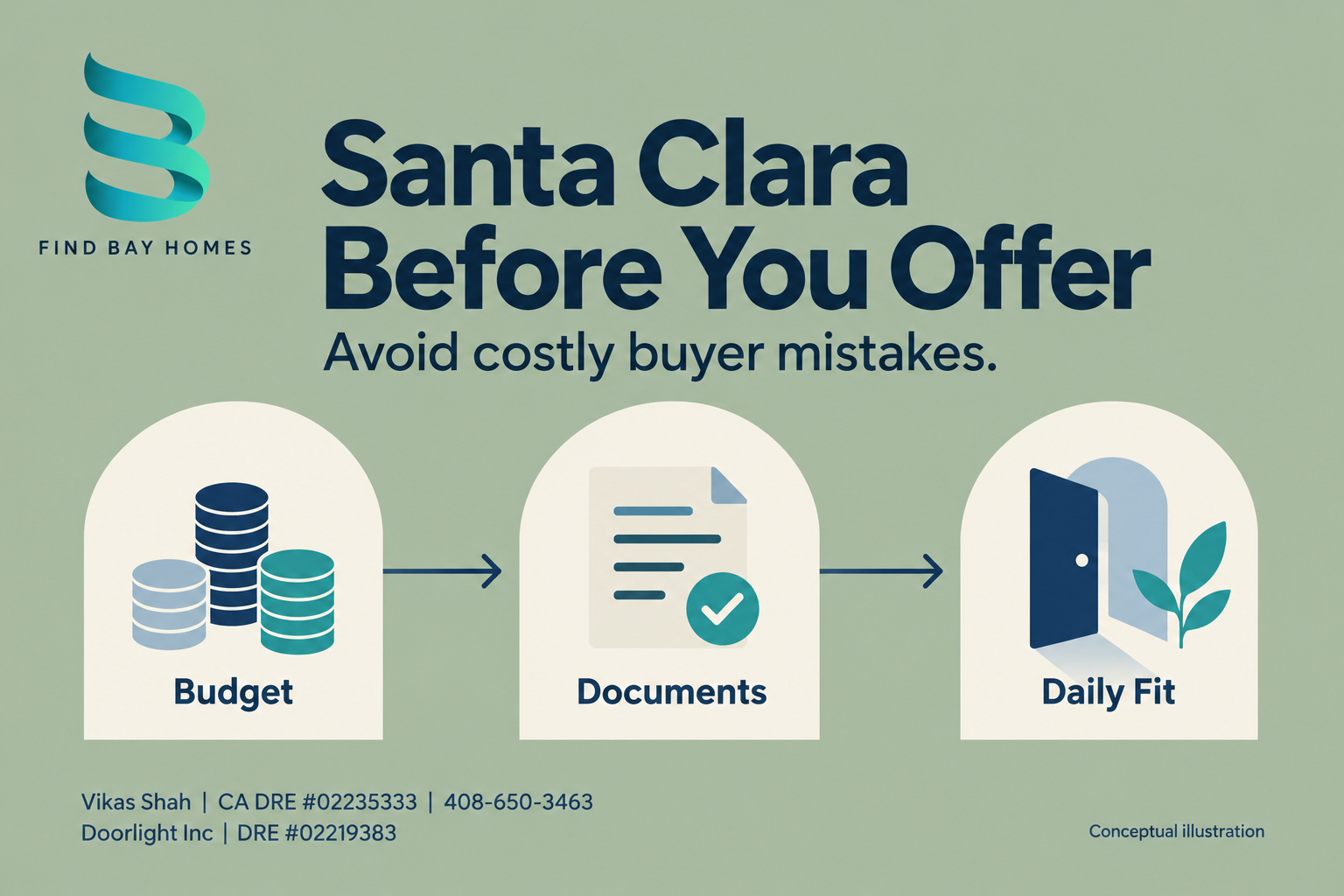
Conceptual illustration, not a photograph of a property or local landmark.
By Vikas Shah | CA DRE #02235333 | 408-650-3463
Reviewed October 9, 2026
Before offering on a Santa Clara home, confirm three things: the purchase leaves enough cash after closing, the documents support how you intend to use the property, and the exact address works for daily life. A preapproval, attractive remodel or neighborhood name does not answer all three. The most expensive mistake can be treating an unanswered question as a completed check.
This guide is a decision checklist for the City of Santa Clara. For market context and the overall buying process, start with the Santa Clara home-buyer guide. Here, the focus is what to verify before you choose a price and contract terms.
1. Raising the offer without recalculating cash left
Monthly affordability and closing liquidity are separate tests. Protect the money you need for known repairs and emergencies before deciding what remains available for a higher offer. An earnest-money deposit generally becomes part of the purchase funds; do not subtract it twice when reconciling the lender and escrow figures.
An original $50,000 higher-offer worksheet
Assume $330,000 available cash, 20% down, a 30-year fixed loan at a hypothetical 6.5%, $18,000 of planned repairs and $30,000 of protected reserves. Closing costs and prepaids are modeled at 2% of price solely for illustration. Actual lender, escrow, insurance and tax estimates replace these assumptions.
| Planning item | $1,200,000 offer | $1,250,000 offer |
|---|---|---|
| Down payment | $240,000 | $250,000 |
| Loan | $960,000 | $1,000,000 |
| Principal and interest | $6,067.85/month | $6,320.68/month |
| Closing costs and prepaids assumption | $24,000 | $25,000 |
| Repairs plus protected reserves | $48,000 | $48,000 |
| Unallocated cash after those items | $18,000 | $7,000 |
| Illustrative total ownership budget | $8,417.85/month | $8,720.68/month |
The monthly totals add an assumed 1.2% annual property-tax planning allowance, $450 HOA dues, $150 insurance, $250 maintenance reserve and $300 utilities. These are invented planning inputs, not a Santa Clara tax quote, insurance quote or typical HOA bill. No mortgage insurance is modeled; actual loan programs may differ. The maintenance allowance is a reserve contribution, not a fixed bill.
The higher offer adds about $302.83 per month and consumes $11,000 of the remaining cash cushion. A household comfortable with the payment increase might still be uncomfortable with only $7,000 unallocated. Supplemental taxes, moving costs or an insurance deductible would need funding from that cushion or a separately designated reserve. Do not count the same reserve twice.
Check: write your maximum price, maximum monthly total and minimum cash remaining as three separate limits. Use the mortgage calculator for payment estimates and compare real property tradeoffs in Santa Clara homes by budget.
2. Using the seller's tax bill as your future budget
The existing assessed value can differ from the value after a purchase. Santa Clara County explains that a change in ownership can produce supplemental taxes based on the difference between old and new assessed values and the applicable proration. A supplemental bill is separate from the annual bill; the county says lenders do not receive a copy automatically.
Check: ask for a parcel-specific annual estimate, a closing-date supplemental estimate and a plan for who pays each bill. Confirm with the lender whether funds are impounded. See the county tax FAQs and our Santa Clara property-tax guide. The 1.2% worksheet assumption above does not replace those checks.
3. Treating “townhome” as proof of ownership responsibilities
The listing's architectural label does not tell you who maintains the roof, windows, balcony or pipes. For attached housing in Rivermark or elsewhere in Santa Clara, read the actual governing documents and allocation of maintenance duties. A well-presented unit does not establish the association's financial condition.
The California DRE's August 2026 guidance highlights governing documents, budgets, regular and special assessments, approved future changes and use restrictions. Request available board minutes and applicable balcony inspection records. Review insurance responsibilities, reserves and litigation with the appropriate advisers.
Check: build a responsibility list for major components and a separate list of restrictions affecting your plans: parking, pets, remodeling, EV charging or rental use. Get the lender's project review and an insurance quote early. Do not assume HOA dues cover every utility or your personal insurance. The housing-type comparison helps organize these differences.
4. Paying for a school expectation without checking the address
A nearby school, marketing description or city name is not written enrollment confirmation. Start with the exact address and serving district. For an SCUSD address, use the district's enrollment page and school locator, then confirm the relevant grade, school year, residency requirements and any capacity or placement issue directly with the district.
Check: distinguish the neighborhood assignment from an optional program or transfer. Review SCUSD open enrollment separately; do not base the purchase on an assumed choice-program seat. Our Santa Clara schools guide adds context, but a dated rating is not an admission promise.
5. Assuming a remodeled room is fully documented
In Old Quad, Central Park-area housing or any older home, a polished kitchen or extra room can look finished while the record trail is incomplete. Ask what work was done, when it occurred and what permits and final approvals apply. Compare the physical layout, seller disclosures and available city records.
Check: use the Santa Clara Permit Center to find the city's record-search route or request help. An absent search result alone does not prove work was illegal, and an issued permit alone does not prove final approval. Resolve gaps with the city and qualified inspectors. Record potential costs and timing before relying on added space or future rental income.
6. Comparing advertised rates instead of the same loan package
A lower rate can come with different points, fees, lock terms or an adjustable structure. Compare written Loan Estimates for the same loan amount and product, issued for comparable timing. Check projected payments, lender charges and estimated cash to close; ask why figures differ.
Check: send the lender the actual property and HOA information. Confirm the remaining conditions for approval and discuss major credit or employment changes before taking action. A preapproval is not a substitute for final underwriting. For product tradeoffs, see fixed versus adjustable-rate mortgages.
7. Testing the neighborhood only on a relaxed weekend
A Lawrence-corridor address may suit a train commute, while a Rivermark address may suit nearby errands; neither label proves that your particular route, parking or schedule works. Start from the home's actual entrance. Walk the route you would use and test the workday journey at your normal time. Include crossings, station access, parking, waiting and the last leg.
Check: return at a second useful time to assess noise and street activity, then confirm parking rights and guest rules in writing. Obtain recent utility usage and identify which charges are included in HOA dues before estimating separate bills. Use our utility-cost worksheet; do not assign every home the same usage or double-count shared services.
8. Letting offer urgency erase unresolved questions
Convert each material unknown into a decision before changing protections. Ask what happens if the appraisal is low, financing is delayed or a specialist identifies a major repair. Record the deadline, evidence needed and the person responsible. Review the specific contract with your agent and legal counsel when needed; no checklist determines deposit rights or cancellation terms by itself.
Check: choose among obtaining more evidence, retaining an appropriate protection, accepting a quantified risk or declining the property. Use the inspection-contingency decision guide for that particular choice. Before sending funds, independently verify instructions by calling a trusted number established earlier; follow the CFPB mortgage-closing scam guidance, especially if an email changes bank details.
Your three-gate offer decision
- Budget: current loan and ownership estimates fit; closing cash and reserves remain adequate.
- Documents: material condition, permit, HOA, insurance and contract questions are resolved or deliberately accepted with advice.
- Daily fit: address-specific school needs, routes, parking and intended use work for your household.
For each gate write evidence / unresolved item / cost exposure / owner / deadline / decision. “Pending” is a useful answer. If an essential requirement remains uncertain, do not turn it into a green light solely because the offer deadline is close.
Frequently asked questions
What is the biggest financial mistake when buying in Santa Clara?
Focusing only on the down payment or mortgage payment. Calculate the whole ownership budget and the cash left after closing, repairs and protected reserves. The worksheet shows how a modest payment change can sharply reduce liquidity.
Should I use the home's current tax amount?
Use it to understand the existing bill, then obtain estimates for the purchase and potential supplemental taxes. The seller's assessment may not represent your future costs.
Can a school listing or an HOA dues amount settle the decision?
No. Verify school information directly for the exact address and review the association's documents for responsibilities, restrictions and financial obligations.
What should I bring to a preoffer discussion?
Your three budget limits, the lender's written estimates, the property documents and the unresolved-item list. Those make the discussion specific enough to choose terms or decide to move on.
Ready to compare a Santa Clara home against your checklist? Contact Vikas Shah to organize the property questions and buying plan. If you also need to sell, the home-value tool provides an estimate to start that conversation, not an appraisal or guaranteed sale price.
Vikas Shah | CA DRE #02235333
Find Bay Homes | Doorlight Inc | Brokerage DRE #02219383
Call 408-650-3463.
Primary sources checked October 9, 2026. Calculations are original hypothetical planning examples; no current mortgage quote, market median, client result or guaranteed outcome is asserted.
FROM OUR BLOG


Fixed vs Adjustable-Rate Mortgages: Bay Area Costs & Reset Risks
A fixed-rate mortgage is usually the clearer fit when you expect to keep the loan for many years or need a predictable principal-and-interest payment. An adjustable-rate mortgage can be worth comparing when its initial savings are meaningful, its fees are competitive, and you could still afford the

Santa Clara Homes by Budget: $1M, $1.5M & $2M Tradeoffs
A $1 million Santa Clara budget can buy an attached home; $1.5 million can create a choice between a larger townhome and a smaller detached house; near $2 million, the examples below show more interior space and a second bathroom in a detached home. These are lessons from four September 2026 closed

Santa Clara Property Taxes: Annual Bills, Supplemental Costs & Buyer Budget
For a Santa Clara purchase, build two tax budgets: the ongoing annual bill based on your new assessment, and the separate cash needed for supplemental bills after closing. On a hypothetical $1.5 million assessment, a 1.20% planning assumption means $18,000 annually, or $1,500 monthly, before any cha