
A fixed-rate mortgage is usually the clearer fit when you expect to keep the loan for many years or need a predictable principal-and-interest payment. An adjustable-rate mortgage can be worth comparing when its initial savings are meaningful, its fees are competitive, and you could still afford the loan if you stay past the first reset. A plan to refinance is an option to explore, not a repayment strategy you can count on.
For a Bay Area buyer borrowing $1.2 million, a hypothetical 5.75% ARM instead of a 6.50% fixed loan saves about $582 a month initially. But a first reset to 7.75% would raise that ARM payment by about $1,405 a month. The useful question is whether the savings, fees and downside fit your household—not simply which advertised rate is lower.
Reviewed October 7, 2026. All rates and loan terms below are illustrative assumptions, not current offers, APRs, lender quotes or approval promises. Calculations use fully amortizing 30-year loans and exclude taxes, insurance, HOA dues and mortgage insurance unless stated.
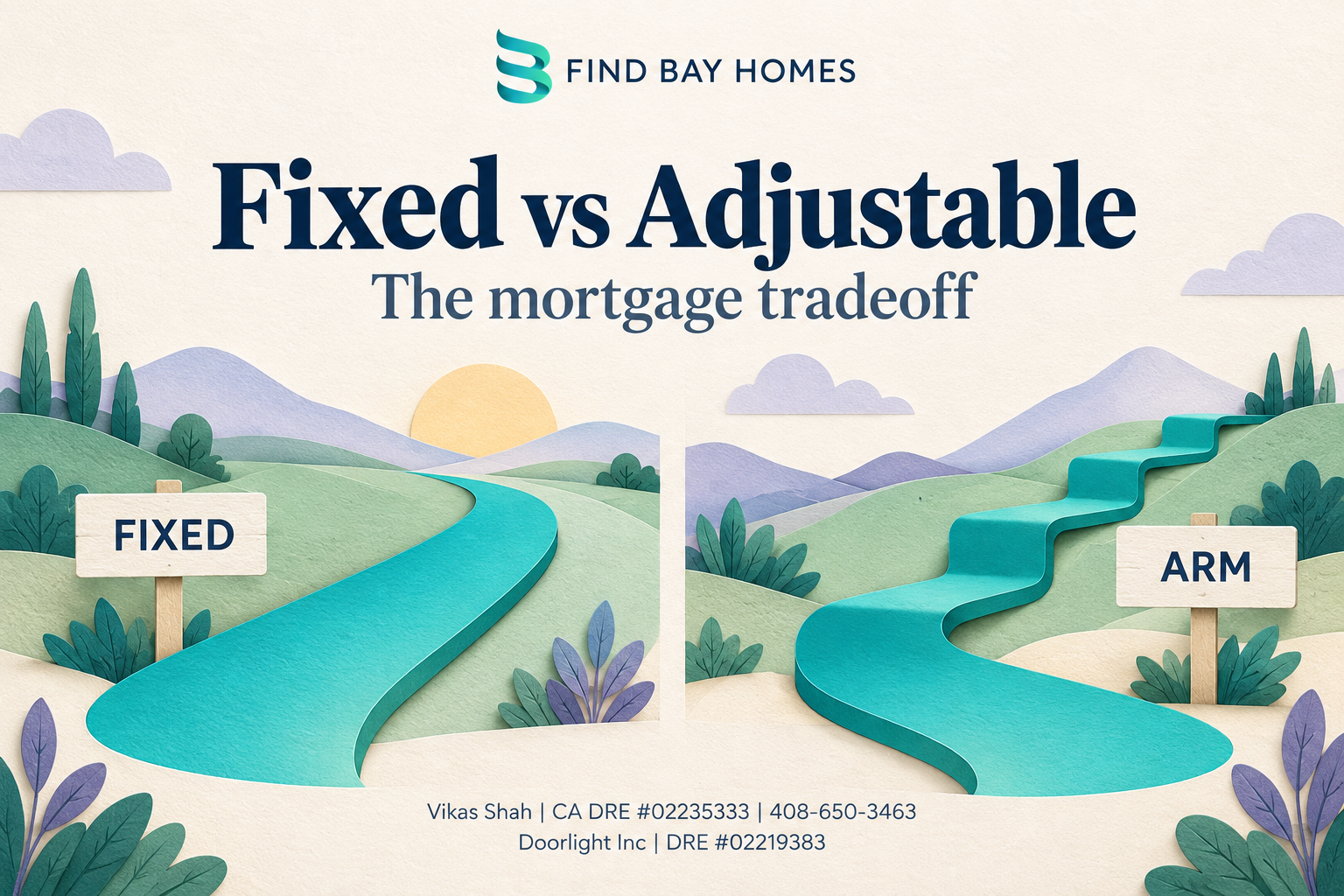
Conceptual illustration; the paths are not a rate forecast.
Fixed versus ARM: what actually changes?
| Question | Fixed-rate loan | Hybrid ARM |
|---|---|---|
| What stays predictable? | The contractual interest rate and scheduled principal-and-interest payment on a standard fully amortizing loan. | The rate during the initial fixed period; the payment can change after that. |
| What happens if market rates rise? | Your existing fixed rate does not reset upward. | Your rate may rise at a scheduled adjustment, subject to the loan's caps and other terms. |
| What happens if rates fall? | A lower payment generally requires refinancing or another approved loan change. | The rate may fall at a scheduled reset, subject to the index, margin and any floor. |
| Can the total housing bill rise? | Yes. Taxes, insurance, HOA dues and other costs can change. | Yes, including those costs plus potential mortgage-rate changes. |
The CFPB's ARM handbook explains this tradeoff and warns that refinancing may not be available when you need it. A job change, reduced income, weaker credit or a lower property value can change your options.
What do 5/6, 7/6 and 10/6 mean?
For these commonly used hybrid-ARM labels, the first number is the initial fixed period in years; the second means adjustments every six months afterward. A 5/6 ARM generally stays fixed for five years and then adjusts every six months. A 7/6 starts adjusting after seven years, and a 10/6 after ten. A 5/1 instead typically adjusts annually after five years. Confirm the actual first-change date in the loan documents; the label alone does not tell you the caps or margin.
A longer initial period can better match a longer expected holding period, but compare its actual rate and fees. “We might move in five years” is less robust than having enough cash flow to keep the home if a move is delayed.
A $1.5 million purchase: the first five years in dollars
This example assumes a $1.5 million purchase, $300,000 down payment and $1.2 million loan. Both loans amortize over 360 months, with no extra principal payments. The ARM stays at 5.75% for the first 60 payments; the fixed loan stays at 6.50%. We initially assume equal loan fees so the rate effect is visible.
| Measure | 30-year fixed, 6.50% | 5/6 ARM, initially 5.75% |
|---|---|---|
| Monthly principal and interest | $7,585 | $7,003 |
| First 60 payments, total | $455,089 | $420,172 |
| Principal remaining after payment 60 | $1,123,332 | $1,113,146 |
| Principal repaid over five years | $76,668 | $86,854 |
| Interest paid over five years | $378,421 | $333,319 |
What the comparison tells you: the ARM releases about $34,917 of cash flow over five years and leaves about $10,185 less principal outstanding. Its interest cost is about $45,102 lower before any fee difference. The cash-flow saving and interest saving are different measures; do not add them together. Figures are independently rounded, so displayed totals may differ by $1.
This is a loan comparison, not a complete affordability calculation. Add the same realistic property-tax, insurance and HOA assumptions to both options. For down-payment alternatives, see the Bay Area down-payment and cash-reserve guide. Use our mortgage calculator for estimated payments; a standard fixed-rate calculation does not automatically model every future ARM reset.
Stress-test the reset before accepting the initial saving
After 60 payments, the example ARM has about $1,113,146 left and 300 months remaining. Re-amortizing that balance gives these possible first-reset outcomes:
| Illustrative rate after year five | Monthly principal and interest | Change from initial ARM payment |
|---|---|---|
| 4.75% | $6,346 | About $657 lower |
| 5.75% | $7,003 | No change |
| 7.75% | $8,408 | About $1,405 higher |
These are scenarios, not probabilities. Under an assumed 2/1/5 upward-cap structure, a 5.75% starting rate can rise by at most two percentage points at the first adjustment, one point at later adjustments, and five points above the original rate over the loan's life. That gives a 7.75% first-reset ceiling and a 10.75% lifetime rate ceiling. Real products can have different caps, floors, rounding and carryover provisions.
If the rate reaches 7.75% for payments 61–66, then rises to 8.75% for payment 67, this example's payment becomes about $9,142, calculated on the remaining balance and 294 months. The original fixed loan would still have its $7,585 principal-and-interest payment. A cap limits the rate movement; it does not promise an affordable dollar payment. Ask for the loan's maximum-payment illustration, not just its first-reset illustration.
The CFPB distinguishes initial, subsequent and lifetime caps. Its separate index-and-margin explanation shows how the reset starts with a market index plus the contractual margin, then applies relevant loan limits. For example, a 4.50% index plus a 2.75% margin produces 7.25% before caps, floors and rounding. The index is not your credit score, and the lender's margin is not the same as a discount point.
How much can extra fees erase?
Suppose the ARM costs $12,000 more upfront than the fixed loan. That is one percentage point of this $1.2 million loan amount. Dividing $12,000 by the approximately $582 monthly payment difference gives a simple cash-flow break-even of about 21 months.
If you sell after 12 months, those extra fees exceed the payment savings to that point. If you keep the loan five years, the initial $34,917 payment saving falls to about $22,917 after that extra upfront cost. This quick calculation excludes the differing principal balances, tax effects, interest on retained cash and any later refinance costs; compare total borrowing cost as well before choosing.
Request quotes on the same day using the same purchase price, loan amount, occupancy, lock period and points or lender credits. On a high-dollar Bay Area loan, a small percentage fee can be a large check. Do not mistake lower estimated property taxes on one lender's form for a cheaper mortgage.
A practical decision rule for three buyer situations
- You expect to stay ten years or longer and want a stable base payment: start with a fixed-rate quote. An ARM needs enough economic benefit and sufficient reset capacity to justify giving up that certainty.
- You expect a shorter stay and can afford a delayed move: compare an ARM whose fixed period extends beyond your realistic timeline. Include selling costs in the broader housing decision and test keeping the loan several years longer than planned.
- The purchase works only at the ARM's introductory payment: reduce the purchase budget, increase sustainable reserves or revisit the loan structure. A lower starting payment does not solve an unaffordable reset.
For a household relying on bonuses or equity compensation, run the higher-payment scenario against dependable income first. A reserve account can bridge a temporary gap; it cannot make a permanently unaffordable payment sustainable. For example, $35,000 divided by the first-reset increase of roughly $1,405 covers about 25 months of that increase alone—not the full housing payment, and less if later resets are higher.
Bring this eight-item worksheet to the lender
- Initial rate, initial fixed period and exact first payment-change date.
- Index name, margin, rate floor and rounding method.
- First, subsequent and lifetime caps; whether unused adjustments can carry over.
- Starting payment, first-reset ceiling and maximum scheduled payment.
- Points, origination charges, lender credits and rate-lock period.
- Whether payments fully amortize; any interest-only period, negative amortization, balloon or prepayment penalty.
- Loan balance and interest-plus-fee cost at your planned exit date.
- A fallback budget if you cannot sell or refinance when expected.
The CFPB Loan Estimate explainer identifies the projected-payment section and ARM tables. Its comparison guide explains how to subtract principal repaid from the five-year payment total to isolate interest and fees. The standard five-year ARM comparison uses assumptions; it is not a prediction of future rates.
Questions Bay Area buyers ask
Is a 7/6 ARM fixed for the full 30-year loan?
No. The initial rate is generally fixed for seven years, then may change every six months. The repayment term and the fixed-rate period are different things.
Can an ARM payment go down?
Yes, if the reset formula and contract allow it. A falling market index does not necessarily translate into an immediate or identical payment reduction because adjustment dates, the margin and any floor matter.
Should I choose an ARM because I expect rates to fall?
Do not make the purchase depend on that forecast. Compare today's written offers and make sure you can carry the loan under adverse reset scenarios. Refinancing has qualification requirements and costs.
Does a fixed-rate mortgage guarantee a fixed total monthly bill?
No. The principal-and-interest component can stay fixed while taxes, insurance, HOA dues and maintenance rise. Keep those costs in the household budget.
What should I do before writing an offer?
Have the lender compare both structures for the actual property and your documented finances. Our Bay Area preapproval guide explains the income, payment and cash documents to prepare.
Connect the loan choice to the home search
Vikas can help compare the property choices and ownership costs behind your purchase budget. A licensed mortgage professional should provide loan quotes, eligibility and product-specific advice. Bring the initial payment, stressed payment and cash left after closing to the home-search conversation.
Vikas Shah | CA DRE #02235333
Doorlight Inc | DRE #02219383
408-650-3463
Educational information, not individualized lending, legal or tax advice. No future rate, refinancing approval, home value or investment return is guaranteed.
FROM OUR BLOG


Santa Clara Property Taxes: Annual Bills, Supplemental Costs & Buyer Budget
For a Santa Clara purchase, build two tax budgets: the ongoing annual bill based on your new assessment, and the separate cash needed for supplemental bills after closing. On a hypothetical $1.5 million assessment, a 1.20% planning assumption means $18,000 annually, or $1,500 monthly, before any cha

Should You Waive an Inspection Contingency? Bay Area Buyer Decisions
Keep an inspection contingency when you can. Consider giving it up only after you understand the property's material condition, have priced the work you are accepting, and can fund that work without exhausting your essential reserves. A seller's inspection packet can reduce uncertainty, but an unrea

Santa Clara Utility Costs: Electricity, Water & Monthly Budget
A Santa Clara home using 500 kWh of electricity and 8 HCF of water in a month would have an estimated $306.21 in the city utility charges modeled below: electricity, water, single-family sewer, a 32-gallon garbage service and the annual-cleanup charge. Gas and internet are additional. That is a work