
Before buying a Bay Area condo or townhome, read the HOA file as a set of connected decisions: what you own, what you must pay, what you may do and what the lender still needs to approve. A low monthly due or a large reserve balance cannot answer those questions alone. Match each important statement to its document, date and responsible person, and resolve material gaps before the relevant contract deadlines.
This guide provides a practical reading order and an original cash-timing worksheet. It applies to buyers considering common-interest properties in places such as Milpitas, Santa Clara and Sunnyvale. The examples are hypothetical, not findings about a particular association. Reviewed October 23, 2026.
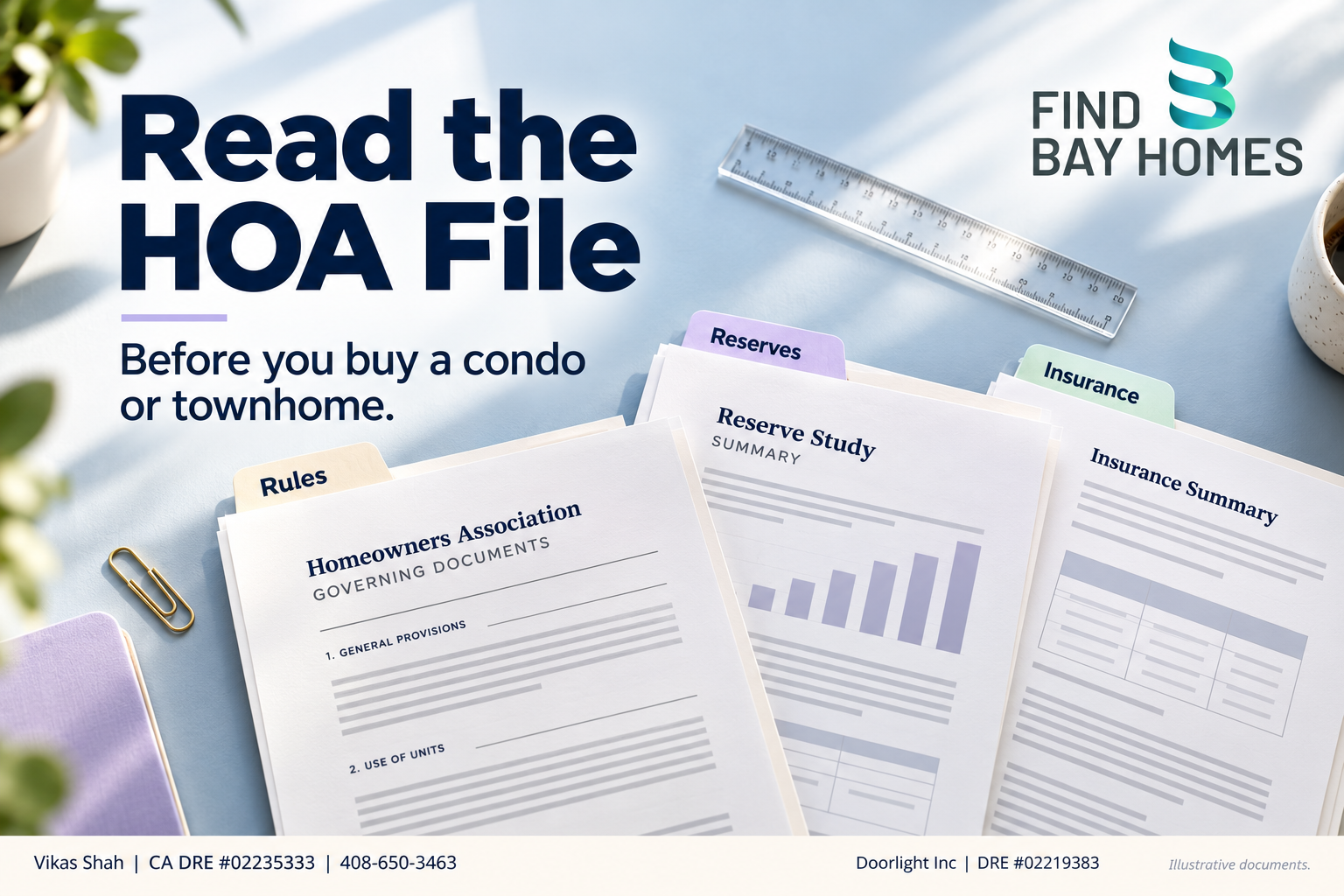
Read the file in an order that answers your buying questions
The California DRE's August 2026 guidance identifies governing documents, annual budget/policy materials, assessment information and approved changes among the seller's disclosures. It also discusses unresolved violations, construction-defect information and the most recent applicable balcony inspection report. Ask your agent and the association's document provider to identify missing or inapplicable items. This reading order is not a substitute for the complete disclosure package.
| Read first | Decision it helps answer | Follow-up question |
|---|---|---|
| CC&Rs, bylaws, rules and amendments | Ownership, obligations and permitted use | Which rule controls the use I actually need? |
| Current assessment statement and approved changes | Recurring charges and near-term cash | What is approved but not yet payable? |
| Budget, reserve study and funding plan | Operating costs and future common work | Which project has a funding or timing gap? |
| Insurance summaries and applicable policies | Association versus owner coverage | What coverage and deductible exposure remain mine? |
| Available minutes, inspection and project records | Whether plans match the financial documents | What changed after the report date? |
| Lender project review | Financing eligibility for this property | What remains unresolved for my loan program? |
Start with ownership and responsibility, not the building's appearance
A home marketed as a townhome may have a different ownership structure from another home with similar walls and stairs. Confirm the legal interest and governing documents. Then make a responsibility list for roof, windows, balcony, exterior, plumbing, yard and parking areas. Write down who maintains, repairs and replaces each relevant item. Do not assume all three duties belong to the same party.
Use a concrete question: “The window frame needs replacement. Which document assigns that cost, and does approval have to come first?” Apply the same approach to planned remodeling, an EV charger, pets, leasing or use of a garage. Record the actual restriction and approval process. An agent's or seller's informal description should not replace the governing text or a written clarification.
If you are still choosing a property category, compare the broader tradeoffs in the Santa Clara condo, townhome and house guide or the Milpitas property-type comparison.
Connect reserves to the work and the year it must be paid
The DRE's Reserve Study Guidelines explain the connection between component responsibilities, replacement costs, remaining life and available funding. The linked guide is dated August 2010; use it for the planning framework, not as a statement of current statutory deadlines.
For each major component, compare the study's cost and timing with the current funding plan. Check whether later inspections or bids changed the scope. Ask how a proposed project will be funded and whether a decision has actually been approved. A study estimate, a contractor bid, an approved assessment and a payment notice represent different stages.
A reserve percentage is a prompt for further questions, not a stand-alone pass/fail score. A reported balance also needs a date and context: committed projects, future contributions and the timing of expenditures. Avoid adding reserves already assigned to one project to the cash supposedly available for another.
Worked example: the same purchase price can leave very different cash
Suppose a buyer has $310,000 available and is considering a $1,200,000 property with 20% down. Assume $24,000 for closing costs and prepaid items and a chosen $30,000 reserve to protect after closing. These are worksheet inputs, not Bay Area averages or lender requirements.
- Down payment: $240,000.
- Cash after down payment and assumed closing/prepaid costs: $46,000.
- Cash above the buyer's protected reserve: $16,000.
Now assume the documents disclose an $18,000 assessment allocated to this unit. If the buyer must fund all of it at closing, cash falls to $28,000, which is $2,000 below the chosen reserve. If the seller pays it in full under the agreed terms, the example's $46,000 remains. Confirm that arrangement in the contract and closing instructions rather than relying on a verbal promise.
If an available plan instead requires $6,000 initially and $12,000 over 24 months, the simplified illustration leaves $40,000 after the initial payment and adds $500 monthly for two years. This assumes no interest or fees. It is not a claim that any association offers such a plan, that it transfers to a buyer, or that a lender accepts it. Obtain the actual terms.
The useful question is whether the timing fits your cash and monthly budget. A $500 monthly installment cannot be treated as though the entire $18,000 disappeared. Add regular dues and other recurring obligations to your financing estimate using the mortgage calculator, and keep the assessment schedule separate from the regular due.
Ask about insurance and financing before the final review deadline
Request the association's coverage information and have your insurance professional explain what the owner policy needs to cover. Ask about deductibles, coverage gaps and any notices of changed or nonrenewed coverage. Do not infer protection from “insurance included” in a listing or from a budget line alone.
Borrower preapproval does not complete the property's project review. Fannie Mae's project standards address matters including certain litigation and critical repairs. Your lender must determine the requirements for your loan and project. A seller credit or stronger borrower finances does not automatically resolve project eligibility.
Use one question log to reconcile conflicting documents
Create a row for each unresolved issue, with six fields: document and page, date, exact issue, person who can answer, written response, and decision deadline. For example, if the budget shows a roof allowance but later minutes discuss a larger project, ask for the current scope, funding decision and unit allocation. Do not silently choose the lower number.
Separate missing, proposed, approved and paid. A missing inspection report is not proof of a defect, and “no assessment approved” does not prove future work will cost nothing. Ask qualified legal, financial, insurance or inspection professionals to address questions within their expertise.
Frequently asked questions
Are low HOA dues automatically better?
Compare what the dues cover, the owner's separate obligations and the funding plan. A lower recurring due can coexist with costs the owner pays separately or with future funding questions.
Can I rely on the seller's summary?
Use it to identify questions, then verify the documents and written responses. Dates, amendments and later decisions may change the picture.
Does an assessment mean I should walk away?
Evaluate purpose, allocation, payment terms, responsibility at closing and the effect on your reserves and financing. The right decision depends on the actual file and your constraints.
Request a buyer planning consultation
Bring your target communities, ownership-cost questions and the unresolved items in the HOA file. Vikas can help organize the property comparison and the next questions for your lender and other professionals. Request a buyer planning consultation or call 408-650-3463. This is not legal advice, an insurance determination or loan approval.
Vikas Shah | CA DRE #02235333
Doorlight Inc | DRE #02219383
408-650-3463 | vikas@findbayhomes.com
FROM OUR BLOG


Bay Area Home Maintenance Budget: Upkeep, Replacements & Cash
Conceptual cover illustration; not a photograph of a property or contractor work. Reviewed October 13, 2026. By Vikas Shah, Realtor with Doorlight | CA DRE #02235333 | 408-650-3463 Budget for home maintenance in three parts: routine upkeep you expect to spend, savings for larger replacements, and ca

Selling a Santa Clara Home: Pricing Evidence, Documents & Offer Net
To sell a Santa Clara home, build the price from comparable closed sales, resolve document questions before launch, and compare offers on estimated net proceeds and execution. A citywide median is context, not a price for your house. A higher offer can leave less cash after credits and extra carryin

How Mortgage Rates Change Bay Area Buying Power
A higher mortgage rate reduces the home price supported by the same monthly budget. But the useful buying-power number includes taxes, HOA dues, insurance and cash left after closing—not just principal and interest. In the original example below, a rise from 6.50% to 7.00% lowers the monthly-budget